How to Play Tambola: Complete Rules, Tickets, and Winning Strategies
Ever walked into a room buzzing with “Tambola!” shouts? That’s how to play tambola in action—a game that turns quiet evenings into wild celebrations. Picture this: aunties clutching tickets, kids yelling numbers, and everyone eyeing that tambola full house prize. Rooted in old British housie, it exploded in India as our go-to for festivals, birthdays, and even office parties. You grab a ticket with numbers from tambola numbers 1-90, mark ’em as the caller hollers, and race to hit tambola winning patterns (lines, corners, full house—your call). Newbies, don’t sweat—tambola rules for beginners are dead simple. I’ve seen first-timers win big on their debut. Let’s break it down, step by casual step.
Understanding Tambola Basics and Origins
Tambola didn’t just pop up yesterday. Back in the 1800s, British folks played housie on ships to kill boredom—sailors marking numbers on makeshift cards. Fast-forward to India, and it got a desi makeover. Now, housie rules mix with local flair, especially during Holi or weddings.
Why does it stick? It’s pure thrill without needing pro skills. Gather 10 folks or 100; it doesn’t matter. One tambola caller pulls numbers randomly. No cheating the odds, but oh, the stories. My neighbor swears a “lucky ticket” vibe exists—stats might disagree, but who cares when fun’s the goal?
Grab basics: tickets, dabbers (those colorful pens or beans), a number bag or app. Games zip by in 15 minutes. Scholars quibble if it’s “skillful” enough, but families vote yes every Diwali. Playing over video? Our guide to hosting Tambola online walks through Zoom, tickets, and prizes without the paper mess.
Tambola Tickets: Structure and How They Work
Nothing fancy here. A tambola 3x9 ticket is your battlefield—three rows, nine columns, exactly 15 numbers scattered around. Five per row, zeros elsewhere. Columns lock ranges: 1-9 leftmost, up to 81-90 on the right. That’s tambola ticket rules in a nutshell.
Why this setup? Keeps things fair and scannable. No two tickets are identical in a pack, endless combos. Print sheets anytime with our free tambola tickets generator—I’ve DIY’d stacks for neighborhood games.
Sketch one out quickly:
| 3 | 15 | 28 | 41 | 67 | 89 | |||
|---|---|---|---|---|---|---|---|---|
| 11 | 24 | 52 | 74 | |||||
| 7 | 19 | 36 | 85 |
Caller says a number? Dab it if it matches. Boom—game on.
Tambola Rules for Beginners – Core Gameplay Mechanics
Alright, beginners: here’s your cheat sheet for the complete set of tambola game rules. Sit in a circle. Caller (pick someone loud) shakes the bag, pulls a token, shouts the number—with flair, like “Kelly’s Eye, number one!” Everyone checks tickets.
Mark fast. Yell your claim: “Top line!” or whatever. Group verifies—no mercy on fibs; pay a fine to the pot. Simple, right?
Prizes roll out early. Nail tambola early five first? Snack’s yours. Keep going till the Tambola full house. Fights over calls? House rules rule—announce ’em first. Short games keep kids hooked; I’ve dragged mine from screens this way.
One tip: multi-tickets amp up excitement, but start with a single.
Tambola Number Calling and the Caller’s Role

Callers are stars. They turn “45” into “halfway there!” or “legs eleven tambola” for 11—kids crack up. Full list of tambola phrases? Gold—see Tambola number calls 1–90 (meanings and nicknames). “Top of the House” (90), “all the threes” (33). Practice ’em; bad calling kills vibe.
Pace it: slow builds suspense, speed rushes endgames. Apps help newbies, but bags feel real. Numbers cluster weird sometimes—five lows in a row?—that’s luck talking. Game theory nerds love analyzing it, but we’re here for laughs.
“The easiest way to get started: use our free online tambola number generator — it calls 1-90 automatically with sound, so you can focus on the fun.”
Pro caller? Energetic, fair, repeats if asked. I’ve hosted 50-person bashes; energy’s everything.
Tambola Winning Patterns and Prize Structures
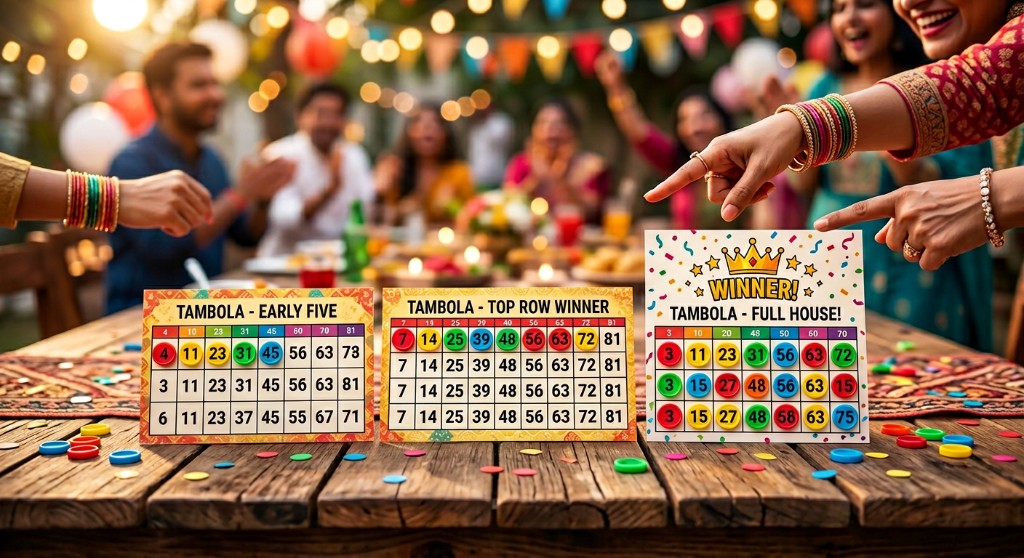
Hits vary, but here’s the lineup of tambola winning patterns:
- Tambola early five: Any five marks. Icebreaker prize.
- Top line tambola or first row tambola: One row done.
- Corners, letters—fancy housie ticket patterns.
- Tambola full house: All 15. The big one.
Tambola prize structure? Flexible. Say Rs. 100 pot: 10 for early five, 20 line, 70 house. Families do chocolates; corporate cash.
| Pattern | Marks Needed | Prize Split Example |
|---|---|---|
| Early Five | 5 | 10% |
| Top/First Line | 5 | 15-20% |
| Any Line | 5 | 20% |
| Full House | 15 | 50-70% |
Customize. Indian twists add “borders” or stars—keeps it fresh.
Variations in Indian Tambola Rules and Housie
Housie rules are strict UK-style; tambola loosens up. Buy multiples? Allowed here. “Teen Patti Tambola” mixes cards—wild, right?
In Rajasthan, we speed-call for kitty parties. Jaipur Diwali? Non-stop — if you’re planning a festival session, our Diwali tambola guide covers dividends, ticket distribution, and kitty-specific setup in full. Purists grumble at extras, but evolution wins. Apps now digitize it, strict on rules, but nothing beats live “legs eleven” roars.
Tambola Hosting Guide: Tips for Smooth Games
Hosting? Easy with my tambola hosting guide. Stock 6x packs of tickets. Clear space, bright lights. Announce rules: fines for noise, verify mandatory.
Tambola hosting tips, straight talk:
- Caller rotates every game.
- Prizes upfront: motivates.
- Timer on claims: 5 seconds.
Big groups? Side pots. Messy claims? Laugh it off, verify quickly. Post-game chai seals it.
Fun Elements for Family Tambola Games and Kids

Family tambola game? Magic. Kids beg for caller duty—teach tambola phrases: “Two little ducks, 22!” Turns math into memes.
Smaller grids for tots. Themes: superhero numbers. My crew does animal noises—11’s a meowing cat. Builds bonds, sharpens ears. Studies back it: better focus, happier homes.
Tambola’s that friend who never disappoints—simple start, endless tweaks. Grab tickets, call “eyes down,” and let chaos reign. Your turn to host?
Try these free tools now:
- Online Tambola Caller — instant number calling with voice
- Tambola Tickets Generator — custom sheets in seconds
- Homepage — all tambola tools in one place
Frequently Asked Questions
How do you play tambola?
Tambola is played with tickets containing 15 numbers arranged in a 3×9 grid. A caller randomly draws numbers 1–90 one at a time; players mark matching numbers on their tickets. The first player to complete a pattern — such as a top line, middle line, or full house — wins that round's prize.
What is tambola?
Tambola is a popular Indian number-calling game derived from the British game of Housie. Players receive tickets with 15 randomly arranged numbers between 1 and 90. As a caller announces numbers one by one, players mark them off their tickets. The first to complete a set pattern wins. It is widely played at kitty parties, Diwali gatherings, office events, and family get-togethers across India.
How do you win at tambola or housie?
To win at tambola, you need to be the first player to complete an announced winning pattern on your ticket — such as Early Five (any 5 numbers), Top Line, Middle Line, Bottom Line, or Full House (all 15 numbers). Playing multiple tickets increases your chances. Stay alert and mark numbers quickly as they are called.
What is the difference between tambola and tombola?
Tambola and tombola are the same game. Tombola is the original British and Italian spelling, while tambola is the commonly used spelling in India. Both refer to a number-calling game played with tickets containing numbers from 1 to 90, identical in rules and format.
How many numbers are in a tambola ticket?
A standard tambola ticket has 15 numbers arranged across 3 rows and 9 columns. Each row contains exactly 5 numbers and 4 blank spaces. The columns follow fixed number ranges: column 1 contains numbers from 1–9, column 2 from 10–19, and so on up to column 9 which contains numbers from 81–90.